Feeling like you know nothing as a MBBS medical intern

Feeling like you know nothing as a medical intern is not a sign that you are falling behind. It is the documented experience of every MBBS intern who is paying close enough attention to see how wide the gap is between what a textbook teaches and what the ward actually asks of you in real time.
By month 3 of your internship, something shifts. You have been on the ward long enough that confusion starts to feel personal rather than circumstantial. The silence after a senior's question in week 11 of medicine carries a different weight than the silence in week 1. Not because you know less now. Because you now understand what the question is actually asking.
“The embarrassment spiral every MBBS medical intern experiences in months 3 to 5 is not a knowledge problem. It is the first sign that clinical thinking is replacing textbook thinking, and the ward has not yet caught up with what you are building.”
Why does knowing nothing as a medical intern feel worse by month 3, not better?
This is the part of the intern year that nobody explains during orientation. The first posting, whether it is medicine, surgery, or paediatrics, arrives with a kind of chaos that feels temporary. You tell yourself you are new, you will learn the rhythms, things will settle.
And the logistical part does settle. You learn the ward round order, which case sheet format your unit prefers, which staff nurse to ask when you cannot find something. The surface confusion fades.
But as the logistical noise quiets, the clinical noise becomes louder. The questions get clearer: why is this patient not improving, what would you add here, what is the next investigation? The clearer those questions become, the more visible the gap between what you can answer and what the ward needs from you. The feeling of knowing nothing does not get worse because you know less. It gets worse because you are now present enough to understand what you do not know. That is the beginning of real clinical thinking, not a failure of it.
Why does blanking on the ward feel so different from not knowing in an exam?
In an exam, not knowing has a structure. You leave the question, move to the next one, return if time allows. The setting is controlled. Nobody is watching in real time. The stakes are visible but the format is familiar.
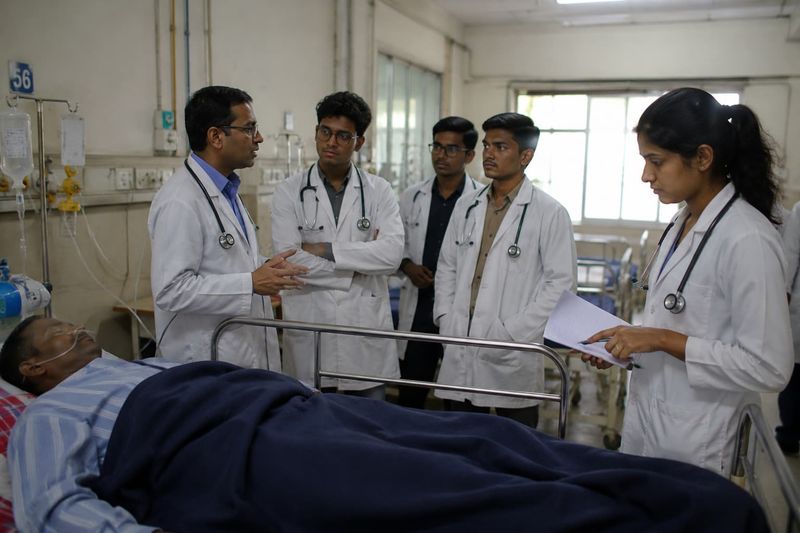
On a ward round in your medicine posting, week 11, the context is entirely different. Your senior asks you to explain the management plan for a patient you have been clerking for three days. You know this patient. You have written in their case sheet every morning. You have watched their vitals. And when the question arrives out loud, the answer does not come.
The difference is not knowledge. The difference is retrieval under observation. Clinical reasoning in real time, in front of a senior, with a patient present, is a cognitive skill that studying alone does not build. In Indian medical internships, the ward round is also a social hierarchy in motion. There is the consultant, the senior resident, the junior resident, and then you. The pressure of that structure is not incidental. It is the exact condition under which your brain is being asked to perform. That is a new skill. You are learning it for the first time, not failing a skill you already have.
What is actually happening when you blank in front of your senior?
There is a specific moment that most interns in their surgery or medicine posting recognise. The senior asks a question. You know you know something about this. And then nothing arrives. The mind goes quiet exactly when it needs to be loud.
What is happening is not a knowledge failure. It is a retrieval failure under cognitive load. You are simultaneously managing the social pressure of being observed, the emotional weight of not wanting to appear incompetent, the clinical context of a real patient, and the task of forming a structured answer. The brain is carrying too many things at once and it drops the most recently learned, most abstractly stored information first.
This is why interns who scored well throughout MBBS still blank on ward rounds. The information is there. The retrieval system is overwhelmed by everything surrounding it. The fix is not more studying at night after duty. The fix is more practice retrieving under conditions that approximate the ward: with another person, out loud, with a real case, under a small amount of pressure. Every intern batch that does this together builds clinical confidence faster than the batch that studies alone.
The embarrassment spiral is one of six moments that every MBBS intern in India moves through across the year. Each one has a name, a month range, and a reason it happens. If you want the full map of what the intern year is actually doing to you from month one to month twelve, read how to survive the medical intern year in India.
What do you actually say when you do not know the answer in front of a senior?
This is the practical question underneath all of this, and it has a specific answer that most interns discover too late in the year.
Say what you know, then name what you are uncertain about. In your paediatrics posting, if your senior asks about the management of a febrile convulsion and you are not confident about the first-line drug, you can say: I know the immediate priority is airway and seizure termination. I am not confident about the first-line medication in this age group and I would like to confirm that before I act.
This is not weakness. This is the clinical habit of naming the boundary of your knowledge in real time, which is one of the most important things a doctor does across their entire career. Seniors who have been on the ward long enough recognise this immediately. What they are watching for is not whether you know everything. They are watching whether you know what you do not know, and whether you are honest about it.
The intern who goes quiet and says nothing is genuinely harder to teach than the intern who says: I know this much, and I am not sure about the rest.
The intern year deserves to be recorded as it happens, posting by posting, because the growth that nobody witnesses in the ward is the growth most worth keeping. That is exactly what Medcoterie was built to do.
Nobody told you what month 3 would feel like. The part where you have been here long enough that confusion starts to feel like your own fault. The part where the embarrassment spiral catches you in a ward round and the room goes quiet and you are standing inside that silence wondering what everyone else is thinking.
That gap between what the ward asks and what you have right now is not a flaw in you. It is the exact shape of where you are in the year. Most MBBS interns in India carry it without saying a word to anyone. You are not the only one standing inside it.
Related: Read about surviving the medical intern year for the full picture of what the intern year actually asks of you.
More from Jagruthie Sadula
More insights from the founder of CuroLynk.


